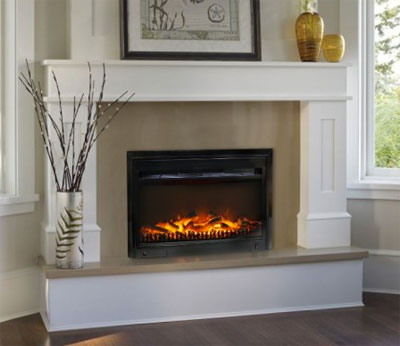
If you’re comparing wood, gas, and electric, the electric option is usually the easiest path. It’s typically cheaper to install, doesn’t need venting, and it’s a clean way to add “zone heat” to the rooms you actually use.
A lot of electric fireplace inserts and stoves can heat around 400 square feet, and some infrared models can go even further—up to 1,000 square feet in the right space. If your family naturally hangs out in one “main” area (living room, family room, kitchen-adjacent den), it often makes more sense to warm that zone instead of paying to heat the whole house equally.
So… how much does it actually cost to run an electric fireplace?
It depends on three things: your local electricity rate, the wattage of the unit, and how many hours you run it. (And yes—some utility companies charge different rates depending on time of day.)
Here’s the practical short version:
According to ElectricFireplacesDirect.com, electric fireplaces may produce less raw heat than some traditional options, but you don’t lose heat up a chimney. That means more of the warmth you pay for stays in the room.
Typical running cost: about 8–23 cents per hour
That range looks huge at first glance, but it makes sense once you factor in different electricity rates across the U.S. and the fact that some people run heat constantly while others use it in short bursts.
Also: you’re not always paying “heater” prices. Most electric fireplaces let you run flames-only mode (no heat) when you just want the cozy look. Since that mode relies on efficient LEDs, it commonly costs around 1–2 cents per hour.
Now let’s do the easiest back-of-napkin calculation.
Watts × Hours Per Day × Your kWh Rate
Let’s use the Paramount electric fireplace insert as an example. It runs at 1500 watts and produces 5,112 BTUs. That’s pretty typical—many electric fireplaces are designed around ~1,500 watts and ~5,000 BTUs. (Higher-BTU units can heat larger areas, but they can also cost more to operate.)
Step 1: Start with the watts (1,500).
Step 2: Multiply by how long you run it per day. Let’s say 5 hours:
1,500 × 5 = 7,500 watt-hours per day (or 7.5 kWh per day).
Step 3: Multiply by your electricity rate (kWh rate) from your utility bill. For this example, we’ll use $0.15/kWh. If you want help running your own numbers, you can use this simple energy cost calculator.
1,500W × 5 hrs/day × $0.15 = about $1.13 per day
That works out to roughly 23 cents per hour when you’re using the heater. For many homes, that’s a fair trade for: no chimney cleaning, no ash cleanup, no gas fumes, and the convenience of remote-controlled flames.
And here’s the part people forget: if you use the electric fireplace as “zone heat,” you may be able to turn your main thermostat down a notch—especially in the evenings—so the fireplace can offset some whole-house heating.
Gas vs. Electric: Which is cheaper?
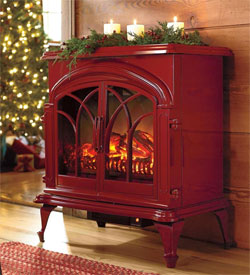
In some areas, the hourly heating cost of gas vs. electric can land surprisingly close—especially once you factor in efficiency and how you actually use the fireplace.
If you’re torn, compare these three things:
- The price of the unit plus installation costs
- The features you care about (thermostat, timer, flame realism, remote control, etc.)
- How often you’ll use flame-only mode (because that’s where electric fireplaces can feel insanely cheap to run)
Portable electric fireplace heaters have efficiency similar to many space heaters—just with a lot more style. And yes, most of them can do flame-only mode too.
Ways to Cut Your Electric Fireplace Costs
Tips for saving money:
- Use flame-only mode when you want ambiance without extra heat (usually pennies per hour).
- If you’re on time-of-use or tiered pricing, avoid peak hours when rates spike.
- Zone heat works best in rooms with standard ceilings—vaulted ceilings can make heat feel less effective because warmth rises.
Frequently Asked Questions
How much does an electric fireplace cost per hour?
Most 1,500-watt fireplaces land somewhere around 8–23 cents per hour depending on your electricity rate. Flame-only mode is commonly ~1–2 cents per hour.
Do electric fireplaces use a lot of electricity?
With heat on, they use about as much as many space heaters (often around 1,500 watts). The good news is you can control how long you run it, and flame-only mode is very low energy.
Is an electric fireplace cheaper than running central heat?
It can be, if you use it for zone heating—warming the room you’re actually in while lowering your main thermostat a bit.
How many square feet can an electric fireplace heat?
Many inserts and stoves can heat around 400 sq ft, and some infrared models can reach up to 1,000 sq ft in the right conditions.
Is flame-only mode worth using?
Yes—if you like the cozy look. It’s the easiest way to get “fireplace vibes” with almost no operating cost.
Reputable Resources for More Info
• Energy Use Calculator (Space Heater Cost)
• U.S. Department of Energy: Energy Saver Guides
• NFPA: Home Heating & Electrical Safety
• ElectricFireplacesDirect.com on Efficiency
Conclusion
Electric fireplaces are usually one of the easiest ways to add warmth and ambiance without the installation headaches of gas or wood. If you remember one thing, it’s this: the math is simple—watts × hours × your kWh rate. And if you use flame-only mode when you don’t need heat, you can keep the cozy fireplace look for just pennies.